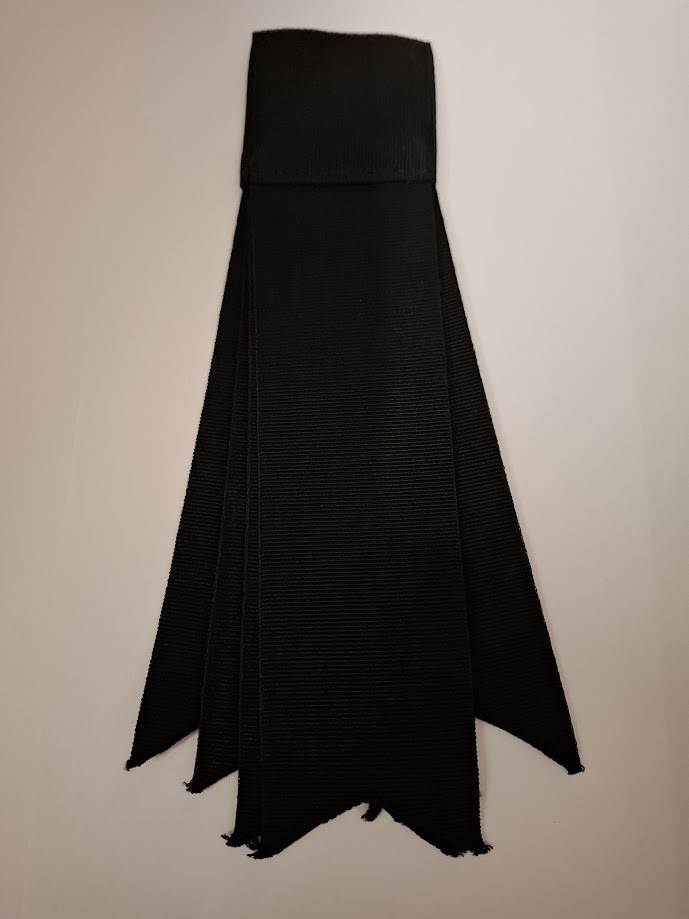
SERGEANTS AND OTHER RANKS COLLAR FLASH

£9.00

THE FLASH.

They are link with the days when soldiers wore pigtails.  These were powdered, greased and in order to protect the red coatee, they were enclosed in what was known as a queue bag.

In July 1808 hair was ordered to be cut close to the neck and the queue was abolished.  At the time the 1st Battalion was in Halifax, Nova Scotia.  At some unknown date officers decided to retain the ribbons with which the queue had been tied.  Using an old slang term for a wig these were known as the ‘Flash’.

The fact that this irregularity of dress was not commented upon until 1834 is almost totally inexplicable, except that for most of the period the battalion was either abroad or in Ireland.

In October 1834, when the Depot Companies arrived at Portsmouth from Ireland, the inspecting General Major General Sir Thomas McMahon, noted “the superfluous decoration on the collar of the coat”  When the Service Companies arrived at Winchester on the 28th November McHahon ordered the removal of the Flash.

At some stage the Commanding Officer, Lieutenant Colonel JC Harrison, conveyed what had happened either personally or in writing, to King William IV.  The Colonel of the Regiment received a letter from the Horse Guards stating that His Majesty had been pleases to approve the Flash “as a peculiarity whereby to mark the dress of that distinguished Regiment”

Until 1900 it was worn only by Officers, Warrant Officers and Staff Sergeants, but in that year Queen Victoria was “graciously pleased to approve of all ranks of the line Regular Battalions wearing on the full dress a “Flash” somewhat similar to that now worn by the Officers of the Regiment”.

In January 1927 the Army Council, at the request of George V, approved the wearing of the Flash by other ranks, both Regular and Territorial “on ceremonial parades and when walking out”

In stock

Category:

Description

THE FLASH.

They are link with the days when soldiers wore pigtails.  These were powdered, greased and in order to protect the red coatee, they were enclosed in what was known as a queue bag.

In July 1808 hair was ordered to be cut close to the neck and the queue was abolished.  At the time the 1st Battalion was in Halifax, Nova Scotia.  At some unknown date officers decided to retain the ribbons with which the queue had been tied.  Using an old slang term for a wig these were known as the ‘Flash’.

The fact that this irregularity of dress was not commented upon until 1834 is almost totally inexplicable, except that for most of the period the battalion was either abroad or in Ireland.

In October 1834, when the Depot Companies arrived at Portsmouth from Ireland, the inspecting General Major General Sir Thomas McMahon, noted “the superfluous decoration on the collar of the coat”  When the Service Companies arrived at Winchester on the 28th November McHahon ordered the removal of the Flash.

At some stage the Commanding Officer, Lieutenant Colonel JC Harrison, conveyed what had happened either personally or in writing, to King William IV.  The Colonel of the Regiment received a letter from the Horse Guards stating that His Majesty had been pleases to approve the Flash “as a peculiarity whereby to mark the dress of that distinguished Regiment”

Until 1900 it was worn only by Officers, Warrant Officers and Staff Sergeants, but in that year Queen Victoria was “graciously pleased to approve of all ranks of the line Regular Battalions wearing on the full dress a “Flash” somewhat similar to that now worn by the Officers of the Regiment”.

In January 1927 the Army Council, at the request of George V, approved the wearing of the Flash by other ranks, both Regular and Territorial “on ceremonial parades and when walking out”

Reviews

There are no reviews yet.

Be the first to review “SERGEANTS AND OTHER RANKS COLLAR FLASH”

The Royal Welch Fusiliers Museum

The Royal Welch Fusiliers Museum is an independent, registered charity, inside Caernarfon Castle. We rely on grant, donations, and visitor support to carry out our mission to preserve, promote, and educate on the history of the Regiment and remember those who served our country. Proceeds from shopping on our site, booking tours, and purchasing tickets to events go towards care for over 20,000 objects in the collection, providing educational opportunities for schools, groups and international audiences, maintaining the museum, and outreach programs to the community.

The mission of the Royal Welch Fusiliers Museum is to:

To maintain a leading international Regimental Museum which portrays the story of over 300 years of service by members of the Royal Welch Fusiliers through exhibitions, education, research, and programs.

To assist in keeping the modern Army and the successor Regiment relevant and to increase public awareness of them.

To collect objects and documents relating to the history of the Regiment.

To conserve and document all archives and documents we collect.

To make the archives and reserve collection accessible to researchers and for educational purposes.

As a nonprofit organization, shopping on our site is one way you can help support our mission.

Processing time

Ready to ship in 1-3 business days from United Kingdom (UK)